Exploring Dongzhai Port Mangrove Tourist Area: A Sea Forest in Haikou
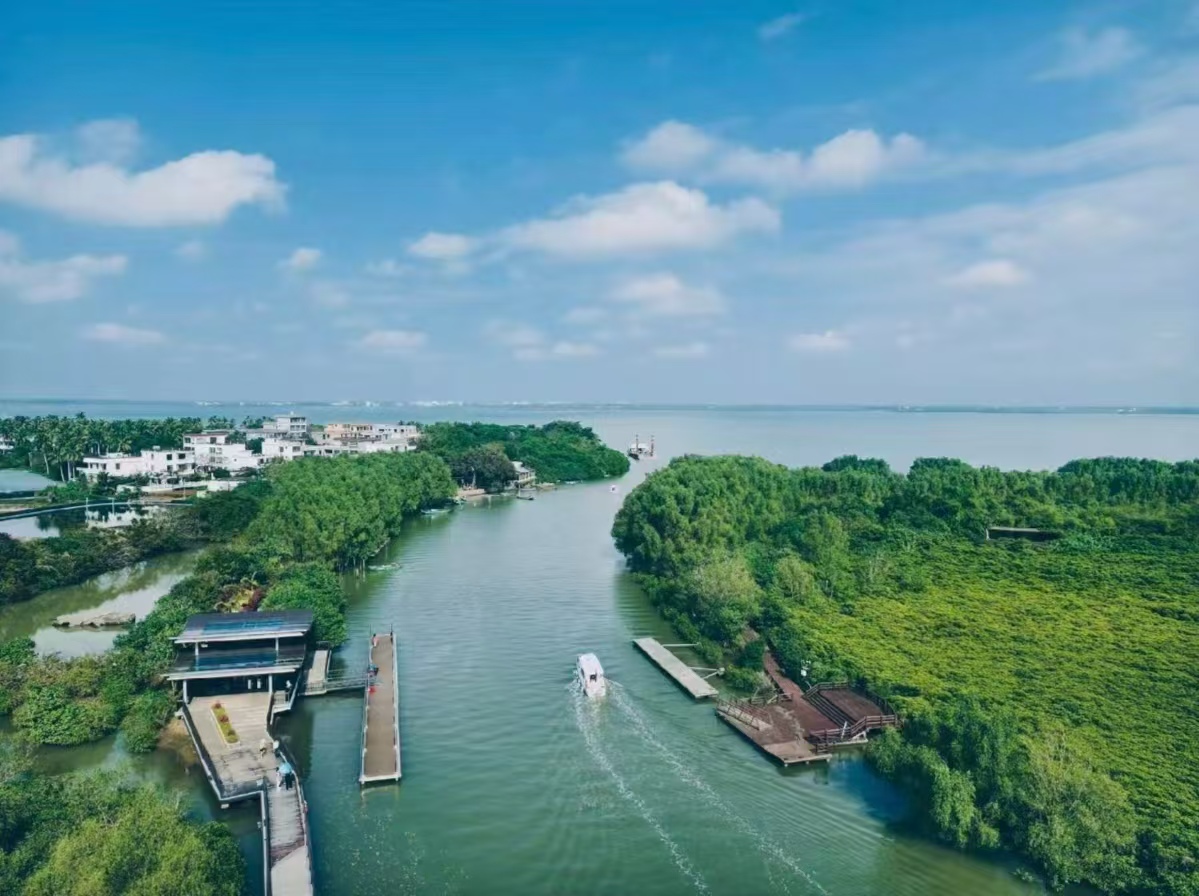
Welcome to the Dongzhai Port Mangrove Tourist Area, located in Yanfeng Town, Meilan District, Haikou. This unique destination invites you to explore an extraordinary “sea forest” — a vibrant mangrove ecosystem shaped by nature and history.
Guided by the principle of “developing while protecting, protecting while developing,” the area is being transformed into a national-level tourist destination with integrated functions: ecological restoration, science education, and rural cultural tourism. The full site spans 457 hectares, with the first phase (74 hectares) featuring:
- A Sea Science Popularization Plank Road
- Electric sightseeing boats
- Service centers and rural markets
- Docks and leisure zones
Discover the Mangrove Forest
You can explore the mangroves by boat or on foot via a 1,700-meter plank road, divided into three themed sections:
- Crab Plank Road
- Fish Plank Road
- Bird Plank Road
Each section offers unique ecological views and ten leisure stops for rest and observation.
A Story Beneath the Sea: The 1605 Earthquake
Dongzhai Port was once a narrow inlet — until a massive earthquake in 1605 reshaped the landscape. Several villages sank, forming the sea area we see today. At low tide, remnants of these sunken villages are still visible near Luwei Village (禄尾村), offering a haunting glimpse into history.
Why Mangroves Matter
Covering 1,734 hectares, the mangroves serve as:
- Natural land builders, trapping sediment
- Biodiversity hotspots, richer than non-mangrove wetlands
- Vital fish nurseries, supporting local fisheries
- Environmental purifiers, cleansing air, water, and soil
- Coastal protectors, with deep roots that resist tides
- Unique viviparous plants, whose seeds germinate on the parent tree
- Salt secretors, adapting to saline conditions
The Moon Tower: A View from Above
Designed by He Jingtang, a renowned architect and academician, the Moon Tower rises 33.5 meters with viewing platforms at 12m, 24m, and 27m. It serves both as an ecological monitoring station and a scenic lookout — perfect for photography and panoramic views.
Sightseeing Boat Route
From Changningtou Dock to Wild Pineapple Island, you’ll pass through lush mangrove corridors. Despite their green appearance, mangroves are called “red trees” due to tannin oxidation, which turns reddish-brown when exposed to air.
Wild Pineapple Island is named after its native trees, whose fruit resembles pineapples but is too tough to eat. The area is a haven for migratory birds, and during low tide, the exposed mudflats teem with fish, shrimp, and crabs — a natural buffet for wildlife.
The Mangrove Museum
At the museum, you’ll discover the history of mangrove conservation, view plant and animal specimens, and learn how local communities have protected this fragile ecosystem.